




From SFI to SFX: A Learner’s Guide
Figuring out your options as a foreigner in Sweden can be quite a challenge, especially when it comes to learning the language. Maybe you’re not enjoying your current course, or perhaps it’s just not challenging enough. I’ve been there myself, and I completely understand how frustrating that can be.
After living in Sweden for two years, I’ve learned a lot about the public options available for learning Swedish. This guide will walk you through the main pathways, offer some advice based on my personal experience, and share feedback from others. Just keep in mind, everyone’s journey is unique, so take what’s useful and leave the rest.
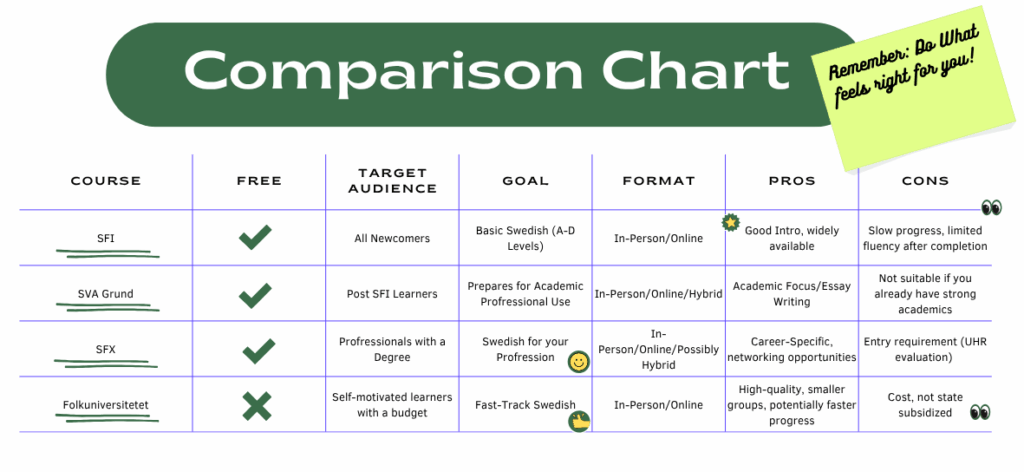
This is the starting point for most newcomers. SFI teaches you the basics of Swedish grammar and conversation, and it’s designed for people from all educational backgrounds. The course has several levels (A through D), and your placement depends on your previous education. For example, if you’re highly educated, you’ll likely begin at C or D level.
Note: SFI also supports people who can’t read or write in any language, which is why levels A and B exist.
You can read more about my personal experience in my article “SFI: A Firsthand Experience.” While I found SFI intensive and somewhat helpful, I wasn’t fluent after six months. Language learning is a long journey, especially as an adult. Don’t be discouraged, progress takes time.
Some Komvux schools offer remote SFI courses. However, feedback from others suggests these are often underwhelming. Instead of structured classes, students are given assignments to complete independently. If you learn best with live instruction and interaction, this might not be ideal.
There are evening or part-time options available if you’re working. These can be a great fit because they often involve more classroom-based learning. Language is a social skill, it’s best learned in a group, not just in front of a screen.
Lorem ipsum dolor sit amet, consectetur adipiscing elit. Ut elit tellus, luctus nec ullamcorper mattis, pulvinar dapibus leo.Once you complete SFI (typically after passing the D course and national exam), you can move on to SVA Grund. This course is more academic and prepares you for university-level Swedish. It includes reading literature, writing essays and reports, and participating in class discussions.
Some people are required to complete SVA Grund if they want to return to their previous careers in Sweden, depending on how their foreign qualifications are recognized.
At my Komvux, there were two study pace options:
I personally chose not to continue with SVA Grund. Having already completed my degree, I didn’t feel the course aligned with my goals. I wanted to improve my Swedish in a more professional context and be around people in similar fields, which brings us to the next option.
In Stockholm and some other areas, there are tailored Swedish courses for professionals under the SFX program. These courses are designed for people with degrees in specific fields, such as:
To enroll, you typically need a degree in the field and must have it reviewed by Universitets- och högskolerådet (UHR). I was accepted into the course for social scientists based on my degree in International Studies. I haven’t started yet, but I’ll share more about my experience once the course begins.
SFX is a great option if you want to move forward in your career without starting over. It focuses on field-specific vocabulary and workplace communication, helping you integrate faster into your professional community.
This is a paid and private option that many people find highly effective. Folkuniversitetet offers small classes, experienced teachers, and a faster-paced curriculum. While it’s more expensive than public options, many students report better results and faster improvement in fluency.
No matter which path you choose, learning Swedish takes time, patience, and effort. Don’t be discouraged if you’re not fluent right away, it’s normal. Try different options, talk to others about their experiences, and most importantly, choose the path that fits your lifestyle and goals. If you are interested in learning more about Swedish culture, check out “Discovering Sweden“.
Good luck on your journey, and feel free to reach out or leave a comment if you have questions or want to share your own experience!